Regulation Theory and Socioeconomic Metabolism to Characterize Economy-Wide Degrowth Patterns: The Case of Special Period Cuba.
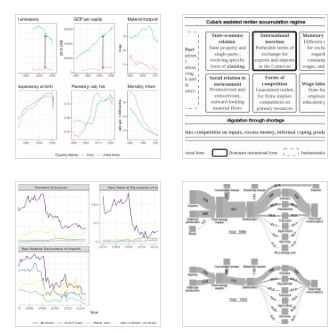
I seek to positively understand the institutional patterns behind system-wide, voluntary metabolism restructurings like degrowth. While economy-wide degrowth is not observable in all of its dimensions, specific aspects can be informed in certain cases. Cuba during the “Special Period” in the 1990s is an example where a drastic metabolism reduction was partly decoupled from progress in social indicators. To integrate socioeconomic and biophysical analysis—still lacking in degrowth research— I combine regulation theory and socioeconomic metabolism. I also introduce a new type of Sankey diagram that incorporates non-technical information external to the datasets. In the Cuban case, initial institutions such as planning, rationing, extended social security, and the absence of hegemonic market relations proved pivotal—though ultimately insufficient—in managing living conditions under biophysical contraction. Further adaptations included State support for grassroots initiatives, partial polycentrization of the planning system or double-track mechanisms combining planning and markets. The absence of democracy, however, precluded systemic post-growth change, lending empirical support to one of the core hypotheses of degrowth theory. These elements are synthesized within the regulation theory framework to suggest that a degrowth mode of production may imply basic needs logics instead of market social relations. Degrowth regimes likely imply planning and only partial decentralization. The diversity and specific features of degrowth-compatible modes of regulation remain open to debate. Further comparative research within the provided framework is needed to refine the characterization of such socioeconomic and biophysical regimes.